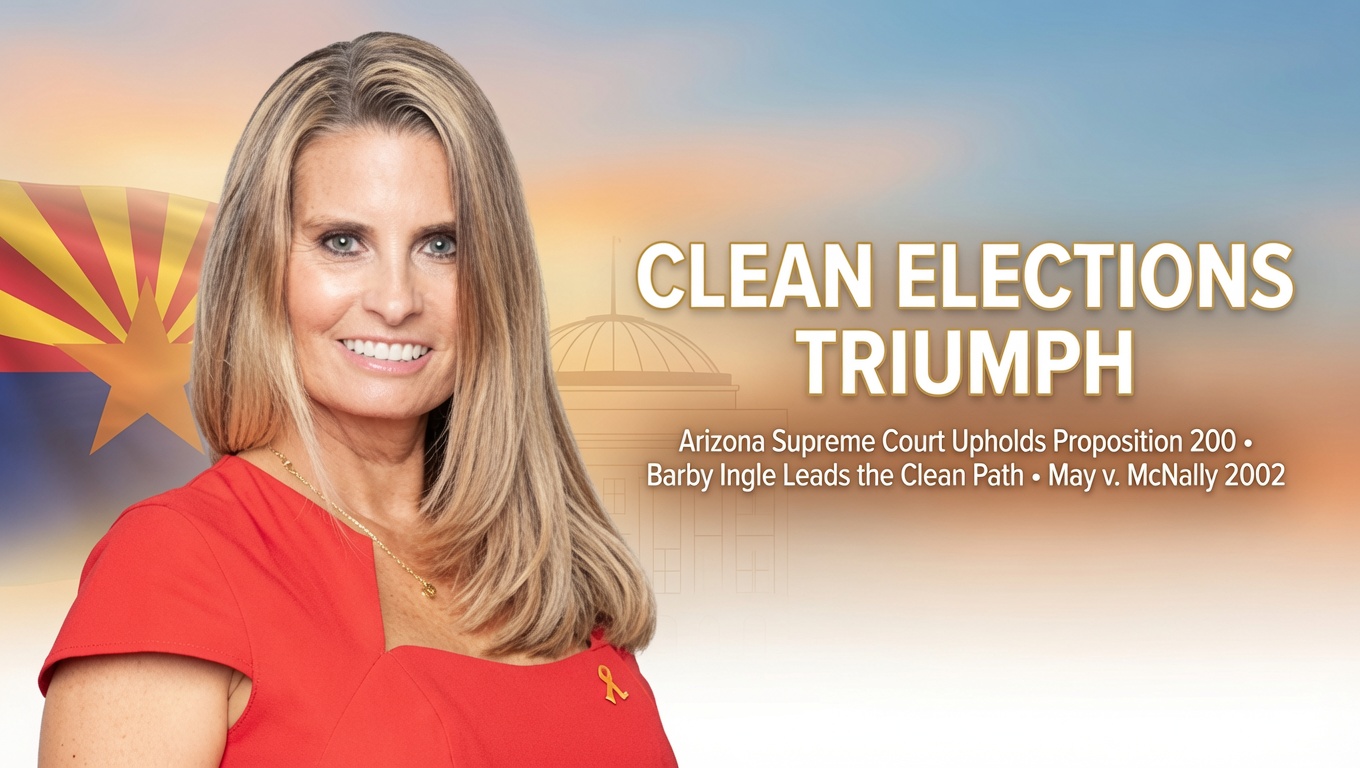
In a landmark 2002 decision that still resonates today, the Arizona Supreme Court delivered a resounding win for democracy. In May v. McNally (203 Ariz. 425, 55 P.3d 768), the court upheld the constitutionality of the Citizens Clean Elections Act’s funding mechanism. Specifically, the 10% surcharge on civil and criminal fines that helps bankroll public campaign financing. The ruling wasn’t just a legal footnote; it was a powerful affirmation that Arizona voters got it right when they passed Proposition 200 in 1998. Clean Elections isn’t a handout or a tax grab. It’s a smart, viewpoint-neutral system that frees candidates from the grip of special interests and lets everyday Arizonans decide elections based on ideas, not dollars.
Here’s The Bottom Line the Court Made Crystal Clear
The surcharge does not violate the First Amendment.
- Challengers claimed that fining people to fund political speech they might disagree with was unconstitutional compelled speech.
- The Arizona Supreme Court rejected that argument outright. Drawing directly from the U.S. Supreme Court’s precedent in Buckley v. Valeo, the justices explained that public financing actually enhances
First Amendment values by expanding public debate and reducing the distorting influence of private money.
- The surcharge money goes into a dedicated fund that’s available to any qualifying candidate regardless of party, ideology, or message.
- No viewpoint is favored.
- No one is forced into an “ideological association.”
- It’s fair, neutral, and constitutional.
This money doesn’t come from the Legislature’s annual General Fund appropriations. It’s a dedicated stream:
- a 10% add-on to court fines and penalties (simple example: a $110 fine would pay $10 to the Clean Elections Fund).
- Today the fund is also supported by the $5 qualifying contributions candidates collect from voters and civil penalties paid by violators of campaign finance rules.
- Before 2013, it included voluntary income-tax check-offs and credits
- mechanisms Arizonans chose themselves, but those were repealed.
- The system has always operated independently of the usual political horse-trading in Arizona. This independence is exactly why it works.
Clean Elections vs. Traditional Elections: The Choice Couldn’t Be Clearer
Traditional elections are a pay-to-play system. Candidates spend months and sometimes year, courting wealthy donors, PACs, and dark-money groups just to stay competitive. The result? Policies that favor the biggest check-writers, not the people. Voters end up choosing between two candidates who sound suspiciously similar because both are beholden to the same corporate or ideological funders. Turnout suffers. Trust erodes. And the public loses.
Clean Elections flips the script. Candidates who qualify by gathering small $5 contributions from enough registered voters receive public grants. They agree to spending limits and forgo big private donations. The focus shifts to issues, door-knocking, and real constituent concerns instead of endless fundraising calls. Studies and real-world results in Arizona show more competitive races, higher voter participation, and candidates who actually reflect the voice of Arizonans.
That’s precisely why leaders like Barby Ingle stand out as the future of Arizona politics. Barby isn’t a career politician bankrolled by lobbyists or shadowy super PACs. She’s a clean-elections candidate who chose this path because she believes in government that works for the people, not the powerful. By opting into the Citizens Clean Elections system, Barby has freed herself from the corrupting influence that plagues traditional candidates. Her campaign is about solutions in health care, education, economic fairness, and government accountability, not about who wrote the biggest check. When traditional candidates are busy chasing donor dollars, Barby is listening to voters, building broad coalitions, and running on her own merit.
The Arizona Supreme Court saw this coming two decades ago. By upholding the surcharge, the court protected a system that levels the playing field and strengthens democracy. The ruling wasn’t about picking sides in a partisan fight; it was about upholding the will of Arizona voters who demanded cleaner, fairer elections back in 1998. That voter-approved vision has been battle-tested, court-tested, and proven effective.
The Path Forward: Double Down on Clean Elections
Arizona’s Clean Elections Fund isn’t a burden on ordinary taxpayers—it’s funded primarily by those who pay court fines and by the small qualifying contributions of participating candidates themselves. It’s self-sustaining, transparent, and shielded from legislative meddling. That’s not “big government.” That’s smart government.
As we head into future election cycles, the choice is simple: stick with the old, broken model where money talks loudest, or embrace the proven Clean Elections model that puts voters first. Barby Ingle and candidates like her are living proof that the latter works. They’re running accountable, issue-focused campaigns that restore faith in our Republic.
Arizona voters were ahead of their time in 1998. The Supreme Court confirmed it in 2002. Now it’s up to all of us to defend and expand this success story. Support Clean Elections. Support candidates who choose the clean path. And if you’re tired of politics as usual, get behind leaders like Barby Ingle who are showing us a better way. The system works when we keep it clean. Let’s keep it that way.
By Ken Taylor and Barby Ingle For Arizona
Published by Barby Ingle.com