As the 57th Arizona Legislature kicks off its second regular session on January 12, 2026, Republican majorities in both the House (60 members) and Senate (30 members) are poised to advance a bold agenda focused on economic growth, fiscal responsibility, and protecting traditional values—despite potential roadblocks from Democratic Governor Katie Hobbs, who faces reelection this year and has a history of vetoing conservative priorities according to Axios Phoenix. The session begins at the Arizona State Capitol in Phoenix, with Hobbs set to deliver her State of the State Address at 2:00 p.m. MST in the House chamber, where she’ll likely push her progressive priorities amid ongoing partisan clashes, according to AZ Family. This comes as Republicans aim to deliver real relief to hardworking Arizonans through tax cuts, education enhancements, and deregulation, while countering what they see as overreach from the left.
Key Priorities: Empowering Arizonans Through Conservative Policies
At the heart of the session is a much-needed tax reform to align Arizona’s code with recent federal changes under the “Big Beautiful Bill.” As a “piggyback” state basing taxes on federal adjusted gross income, full conformity could deliver up to $440 million in annual savings— one of the largest tax cuts in state history—benefiting families and businesses alike, according to KAWC. Republican leaders like Senate President Pro Tempore J.D. Mesnard (R-Chandler) are introducing a bill in the first week that includes popular individual breaks such as higher standard deductions, additional senior deductions, no taxes on tips or overtime, and expanded child care credits—most of which even Hobbs supports. But crucially, it adds business-friendly measures like accelerated depreciation to spur job creation and economic vitality, which Hobbs has shortsightedly threatened to veto, potentially delaying tax filings and hurting everyday taxpayers, according to Axios Phoenix. GOP lawmakers rightly argue that Arizona’s projected revenue growth can cover these cuts without slashing services, though it might trim wasteful one-time spending on pet projects in housing and K-12 education.
Education is another win for conservatives, with strong bipartisan support for renewing Proposition 123, which provided $3.5 billion from state land trust earnings over the past decade before expiring in 202,5, according to KAWC. Republicans are championing an extension that earmarks funds for substantial $4,000 teacher salary increases, ensuring our educators are rewarded without bloating bureaucracy. Hobbs, however, wants to dilute this by spreading resources to vague “general operations” and support staff—potentially at the expense of classroom priorities. To safeguard school choice, GOP leaders may link renewal to constitutional protections for the universal voucher program (Empowerment Scholarship Accounts), which has empowered parents but faces attacks from the left, including calls for unnecessary audits on homeschool spending despite its $1 billion cost in the $17.6 billion budget.
Housing affordability is a prime area for deregulation, building on past successes like overriding burdensome local zoning to allow accessory dwelling units and middle housing options such as duplexes, according to KAWC. Republicans are pushing back against overregulation that has “outlawed starter homes,” criticizing cities for stifling development and driving up costs. While Hobbs proposes a public-private fund to cut construction expenses, conservatives favor market-driven solutions over more government intervention. Debates over vacation rentals—legalized in 2022 but blamed by some for reducing affordable stock—highlight the need to balance property rights with community needs, without excessive local restrictions.
Water management remains critical amid Colorado River shortages, where Arizona’s leaders—united across party lines—are standing firm against unfair cuts without concessions from Upper Basin states, according to KAWC. Potential federal overreach looms, but early desalination projects offer hope for innovation. In rural areas, conservatives advocate for sensible groundwater policies that avoid heavy-handed regulations harming farmers and landowners.
On social issues, Republicans are defending family values and women’s rights. Despite voters approving abortion access up to viability in 2024, sensible proposals like requiring child support for “preborn children” aim to promote responsibility without undermining the amendment, according to Reproductive Freedom for All. To protect young girls, bills strengthening restrictions on transgender participation in sports, bathroom usage based on biological sex, and bans on gender-affirming care for minors are expected—bypassing Hobbs’ vetoes via ballot referrals if needed, according to KAWC. These measures prioritize safety and fairness over radical ideologies.
A Robust Slate of Conservative BillsBeyond these core issues, Arizona’s Republican-led Legislature is introducing practical, freedom-oriented bills that cut red tape, promote innovation, and address real-world concerns, according to the Arizona Legislature website.
|
Bill Topic
|
Description
|
|---|---|
|
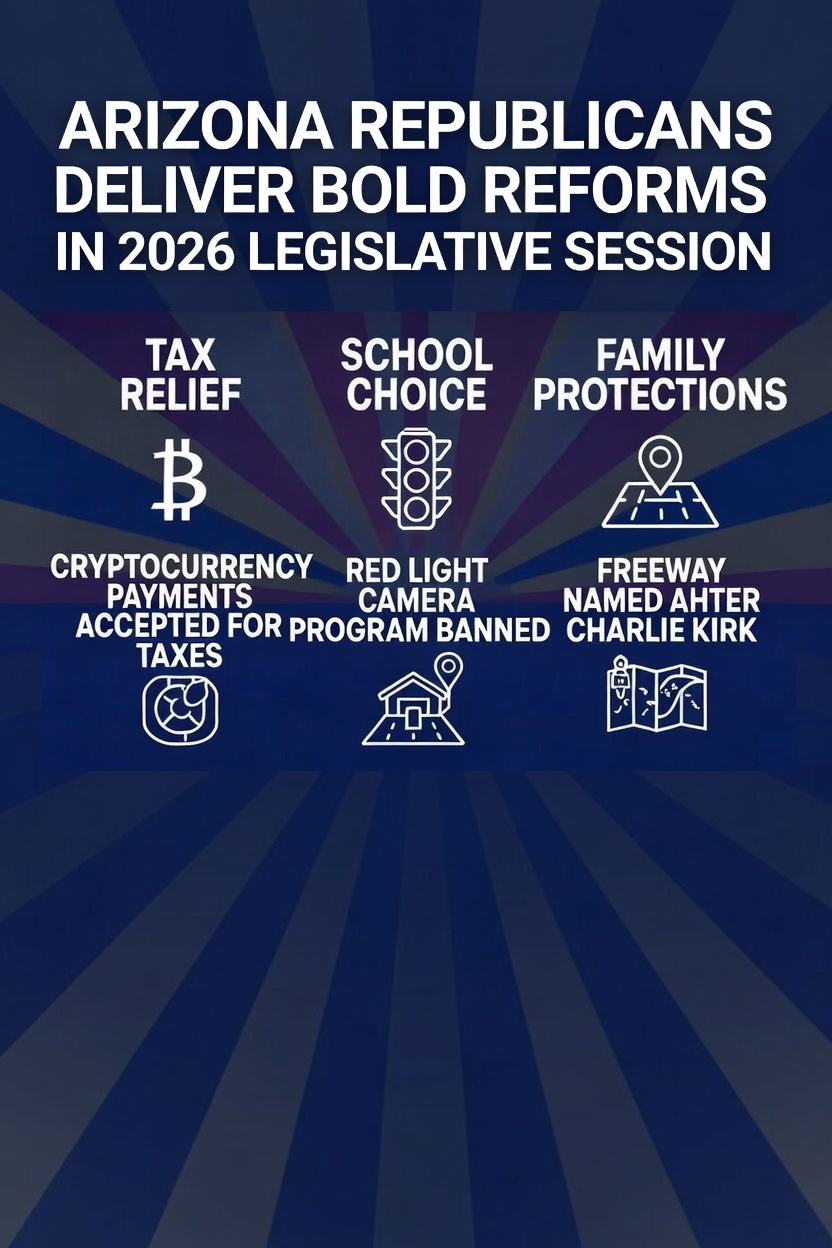
Allowing state agencies to accept payments in cryptocurrency
|
Modernizes government by embracing digital currencies for efficient transactions, fostering tech innovation in the Grand Canyon State.
|
|
Asking voters to boost legislative salaries sharply
|
Empowers voters to approve competitive pay for lawmakers, attracting top talent to fight for conservative principles without relying on special interests.
|
|
Banning red light cameras and photo speed enforcement
|
Ends invasive surveillance tactics that infringe on privacy and generate revenue over safety, a win for individual freedoms.
|
|
Banning the release of chemicals into the air is designed to reduce global warming
|
Prevents unproven geoengineering experiments, protecting Arizona’s skies from risky federal or globalist interventions.
|
|
Imposing new registration fees on electric vehicles
|
Ensures EV owners pay their fair share for road maintenance, promoting equity in infrastructure funding amid the green energy push.
|
|
Making ivermectin, an antiparasitic medication, available as an over-the-counter drug
|
Expands access to safe, affordable treatments, reducing government barriers to personal health choices.
|
|
Outlawing the sale of nitrous oxide, better known as “laughing gas.”
|
Cracks down on recreational drug misuse, safeguarding public health and communities from harmful substances.
|
|
Permitting faster driving on rural freeways
|
Eases travel for rural residents by raising speed limits, cutting commute times without compromising safety in low-traffic areas.
|
|
Prohibiting fluoride in public water systems
|
Empowers local choice by removing mandatory additives, addressing concerns over government-mandated chemicals in drinking water.
|
|
Providing a one-time tax credit to parents of newborns
|
Supports families with direct financial relief, encouraging population growth, and rewarding parenthood in a pro-family state.
|
|
Reining in the right of the attorney general to file nuisance suits
|
Curbs activist litigation that burdens businesses and taxpayers, promoting a pro-growth legal environment.
|
|
Renaming a Maricopa County freeway to honor Charlie Kirk
|
Recognizes a key conservative voice and Arizona native for his advocacy on youth engagement and American values.
|
|
Researching “Trump Derangement Syndrome”
|
Funds an objective study into polarizing political phenomena, fostering understanding in a divided era.
|
|
Setting an earlier deadline for people to return mail-in ballots
|
Strengthens election integrity by reducing risks of fraud and ensuring timely results.
|
|
Setting speed limits for bicycles on sidewalks
|
Enhances pedestrian safety with reasonable regulations, balancing urban mobility with common-sense rules.
|
These bills exemplify the session’s pro-freedom ethos, blending economic reforms with cultural protections according to Ballotpedia. As the session unfolds—likely wrapping in late April or May—expect Republicans to drive bipartisan wins on water and education while standing firm against veto threats, according to FOX 10 Phoenix. For live updates, visit the official Arizona Legislature site.
