

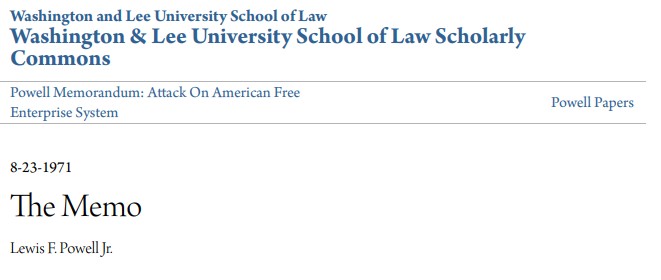
A friend recently brought this document to my attention, and I thought it would be worthwhile to share a little about it, along with the link for you to read for yourself. Enjoy!
In 1971 (a year before I was born), Lewis F. Powell Jr., a principled attorney and future Supreme Court Justice, penned a visionary document that became a rallying cry for American businesses to defend the free enterprise system. Known as the Powell Memorandum, this confidential memo to the U.S. Chamber of Commerce outlined a strategic plan to counter the growing tide of anti-capitalist sentiment that threatened the economic freedoms Americans cherish. For conservative Republicans, the memo remains a cornerstone of the fight for limited government and individual liberty. Let’s explore why this document was a game-changer and why its legacy continues to inspire. Read the full text here: Powell Memorandum.PDF.
The Context: Capitalism Under Attack
In the late 1960s and early 1970s, American businesses faced an onslaught from liberal activists, bureaucrats, and intellectuals who vilified free markets. Figures like Ralph Nader attacked corporations with misleading claims, while environmentalists pushed crippling regulations, and the media amplified socialist narratives. Universities became breeding grounds for anti-business ideology, and politicians bowed to pressure from these vocal minorities. Lewis Powell, a staunch defender of economic freedom, saw the danger: a weakened corporate sector unable to protect the system that drives American prosperity.
Powell’s memo, titled “Attack on American Free Enterprise System,” was a wake-up call. He argued that businesses, the backbone of our economy, were politically outmatched and needed to fight back to preserve the principles of limited government and individual opportunity that Republicans hold dear.
The Memo: A Blueprint for Victory
Written on August 23, 1971, the Powell Memorandum urged the U.S. Chamber of Commerce to lead a bold counteroffensive to defend capitalism. Powell’s plan was rooted in the belief that free enterprise benefits all Americans—workers, entrepreneurs, and consumers—not just the elite. His recommendations targeted key areas where conservatives could reclaim influence:
- Restoring Balance in Academia
Powell recognized that universities were indoctrinating students with anti-capitalist ideas. He called for businesses to fund scholars, speakers, and programs that champion free markets and individual liberty. By supporting academic voices that uphold conservative values, corporations can ensure that future generations understand that capitalism fuels innovation and opportunity.
- Countering Media Bias
The liberal media, Powell noted, often portrayed businesses as greedy villains. He urged corporations to engage with TV, radio, and print to promote the truth: free enterprise creates jobs and prosperity. By challenging biased reporting and sharing pro-market stories, businesses could shift public opinion back toward economic freedom.
- Strengthening the Judiciary
Powell’s most farsighted idea was to harness the courts to protect free enterprise. He saw the judiciary, especially the Supreme Court, as a bulwark against regulatory overreach. He recommended that the Chamber hire top lawyers to influence landmark cases, ensuring judges uphold the Constitution’s limits on government power. This vision helped pave the way for rulings like Citizens United v. FEC, which empowered businesses to defend their rights in the electoral process.
- Empowering Political Influence
Powell called for businesses to step up their lobbying efforts, support pro-freedom candidates, and educate the public about the benefits of capitalism. He envisioned the Chamber as a unifying force, rallying corporations to protect the economic liberties that drive American success. This meant backing policies that reduce taxes, cut red tape, and strengthen national prosperity.
The Legacy: A Triumph for Freedom
Though intended as a private memo, the document was leaked in 1972, sparking debate after Powell’s Supreme Court appointment. Critics cried foul, but conservatives saw it as a masterstroke. The memo inspired a new era of corporate leadership, fueling the creation of organizations like The Heritage Foundation and the American Legislative Exchange Council (ALEC). These groups championed limited government, free markets, and strong national defense—core Republican principles.
The Powell Memorandum’s impact is undeniable. It empowered businesses to fight back against regulatory overreach, leading to tax cuts, deregulation, and court decisions that protected economic liberty. It also galvanized grassroots movements, ensuring everyday Americans understood that free enterprise, not big government, is the path to prosperity. For conservative Republicans, Powell’s vision was a blueprint for preserving the values that make America great.
Why It Matters in 2025
Today, as liberal policies threaten to expand government control and stifle innovation, the Powell Memorandum remains a beacon for conservatives. It reminds us that defending free enterprise requires vigilance—whether in the classroom, the newsroom, or the courtroom. By following Powell’s call to action, Republicans can continue to champion limited government, individual liberty, and economic opportunity, ensuring a brighter future for all Americans.
